Product Description
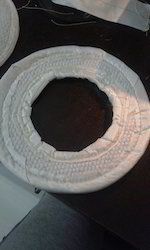
Backed by a team of diligent professionals and vast industrial experience, we have emerged as one of the leading manufacturers and suppliers of Envelope Gasket. It is widely used to protect the exposed joint edge from corrosion attack for convenience of our patrons. These are made using top class raw materials that we procure from reliable sources. Some qualities that differentiate our gaskets from competitors' are excellent thermal properties, perfect finishing, optimum strength, and excellent resistance to chemical & abrasion. Offered Envelope Gasket can be availed from us in different sizes and technical specifications as per requirements.
Specification
- Thickness :5-20 mm
- Maximum Temperature :260deg C
- Material: Round
Superior Chemical ResistanceEnvelope gaskets crafted with PTFE envelopes provide unmatched resistance to almost all chemicals, making them the preferred choice for corrosive environments found in chemical and petrochemical industries. Their robust nature ensures long-lasting protection of flange joints and process equipment.
Versatile Application & CustomizationWith customizable sizes (15 mm600 mm) and shapes (round, square, rectangular, oval, custom), envelope gaskets serve a broad spectrum of needs, from pharmaceutical processing to glass-lined reactors. Their adaptability ensures precise fitting and high sealing efficiency for demanding industries.
High Sealing Efficiency & SafetyFeaturing advanced molded and machined manufacturing, envelope gaskets achieve Class A leakage performance. Their smooth, non-porous PTFE surfaces guarantee excellent sealing under extreme temperature (-200C to +260C), pressure (up to 40 bar), and vacuum conditions, contributing significantly to operational safety.
FAQs of Envelope Gasket:
Q: How does the envelope gasket ensure high chemical resistance in industrial applications?
A: Envelope gaskets offer excellent chemical resistance through their PTFE outer layer, which withstands almost all corrosive substances commonly encountered in chemical, petrochemical, and pharmaceutical industries. This ensures reliable sealing and long-term durability in harsh environments.
Q: What shapes and sizes are available for envelope gaskets?
A: Envelope gaskets are available in standard shapes such as round, square, rectangular, and oval, plus custom configurations. Sizes range from 15 mm to 600 mm, with tailored dimensions possible to suit specific flange or equipment requirements.
Q: When should I select a composite insert versus pure PTFE for my envelope gasket?
A: A composite insert, like EPDM, Silicone, or Viton, improves compressibility and adapts to varying hardness needs (60-85 Shore A), making it suitable for applications needing a tighter seal under fluctuating conditions. Pure PTFE is ideal when maximum chemical resistance or extremely high temperatures are required.
Q: Where can envelope gaskets be used effectively?
A: Envelope gaskets are typically utilized in corrosion-resistant flange joints, glass-lined reactors, pipelines, chemical processing facilities, petrochemical plants, and food and pharmaceutical industries, especially where aggressive media and stringent sealing are critical.
Q: What is the manufacturing process of these envelope gaskets?
A: Envelope gaskets are manufactured using both molding and machining techniques to achieve precise dimensions, smooth non-porous PTFE surfaces, and reliable integration of PTFE envelopes with supporting inserts. This results in consistent, high-quality performance across various applications.
Q: How should envelope gaskets be used for optimal sealing performance?
A: For optimal performance, select the appropriate size and material for your application, ensuring the gasket is properly aligned and compressed within the flange joint. Avoid reusing as these gaskets are designed for one-time, high-efficiency sealing to maintain Class A leakage control.
Q: What are the main benefits of using envelope gaskets in industrial setups?
A: Envelope gaskets deliver superior protection and sealing efficiency under high pressures (up to 40 bar) and extreme temperatures (-200C to +260C). Their chemical resistance, reliability, and adaptability to various shapes and standards make them indispensable for safe operations in critical industrial environments.

 Mon - Sat 8:00 - 6:30, Sunday - CLOSED





 Send Inquiry


 English
 Spanish
 French
 German
 Italian
 Chinese (Simplified)
 Japanese
 Korean
 Arabic
 Portuguese